What Input×Gradient Misses: The Curvature Behind Integrated Gradients
Intro
Series: Integrated Gradients (Part 1 of ?)
Nav: Part 1
This blog post assumes familiarity with Integrated Gradients1 and won’t introduce the method
This is Part 1 of a short series on Integrated Gradients (IG). It is based on work I have been doing a very long time ago, not long after the paper, Axiomatic Attribution for Deep Networks1, was published.
My main interest at that time was to use IG for optimization and/or pruning. This led me down a rabbit hole with some results that are at least not completely uninteresting (I hope).
The first result, presented in this post, might be obvious to the mathematically more inclined reader. In short it states that IG is exactly a first-order term corrected by a path-averaged curvature term. This first-order term is exactly Input×Gradient, introduced in Not Just a Black Box2. This will be derived in this blog post. The original derivation was pretty messy. This blog presents a cleaned up version via integration by parts, which was absolutely not the path I initially took.
Main result
For the straight-line path from baseline $x_0$ to input $x$, with displacement $s := x - x_0$, Integrated Gradients can be written exactly as
\[\mathrm{IG}(x) = s \odot \nabla f(x) - s \odot [\bar{H} s],\]where
\[\bar{H} = \int_0^1 \alpha \, \nabla^2 f(x_0 + \alpha s) \, d\alpha.\]So IG is not just an averaged-gradient heuristic: it is exactly Input×Gradient (or more precisely Gradient×Input-Difference) plus a curvature correction accumulated along the path.
In the following we will set up the notation and derive the result above.
IG Formulation
Notation. Let $f: \mathbb{R}^n \rightarrow \mathbb{R}$ be a $C^2$ function. We write $\nabla f \in \mathbb{R}^n$ for the gradient and $\nabla^2 f \in \mathbb{R}^{n \times n}$ for the Hessian (we’ll need this later). For vectors $a, b$, we use $a \odot b$ for elementwise multiplication.
Choose a baseline $x_0$ and define the displacement $s := (x - x_0)$. The straight path is
\[\gamma(\alpha) = x_0 + \alpha s, \quad \alpha \in [0,1].\]Writing $\hat{x} := \gamma(\alpha)$, the IG attribution vector is
\[\mathrm{IG}(x) = s \odot \int_0^1 \nabla f(\hat{x}) \, d\alpha.\]A second order view
We first note that conveniently due to the linear path the path tangent is constant:
\[\frac{d\gamma}{d\alpha} = s.\]By the chain rule, the gradient derivative along this path is
\[\frac{d}{d\alpha} \nabla f(\gamma(\alpha)) = \nabla^2 f(\gamma(\alpha)) \frac{d\gamma}{d\alpha} = \nabla^2 f(\hat{x}) s.\]Apply $\int u \, dv = uv - \int v \, du$ with
- $u = \nabla f(\hat{x}) \Rightarrow du = \bigl(\nabla^2 f(\hat{x}) s\bigr) d\alpha$
- $dv = d\alpha \Rightarrow v = \alpha$
to get
\[\int_0^1 \nabla f(\hat{x}) \, d\alpha = \Bigl[\alpha \nabla f(\hat{x})\Bigr]_0^1 - \int_0^1 \alpha \, \nabla^2 f(\hat{x}) s \, d\alpha.\]The boundary term is $ [\alpha \nabla f(\hat{x})]_0^1 = \nabla f(x), $ since $\hat{x}=x$ at $\alpha=1$ and $\hat{x}=x_0$ at $\alpha=0$. Therefore,
\[\int_0^1 \nabla f(\hat{x}) \, d\alpha = \nabla f(x) - \underbrace{\int_0^1 \alpha \, \nabla^2 f(\hat{x}) \, d\alpha}_{\bar{H}} s.\]Multiplying both sides by $s$ elementwise gives the second-order form of IG:
\[\mathrm{IG}(x) = s \odot \nabla f(x) - s \odot [\bar{H} s].\]Connection to Input×Gradient
The first term, $s \odot \nabla f(x)$, is the Gradient×Input-Difference attribution. Many readers reserve Input×Gradient for the special case $x_0 = 0$, so that $s = x$; this is the Gradient×Input method discussed in Not Just a Black Box2, and summarized in Ancona et al.3. IG adds the second-order correction $-s \odot [\bar{H} s]$. In particular, if the baseline is zero ($x_0 = 0$), then $s = x$ and
\[\mathrm{IG}(x) = x \odot \nabla f(x) - x \odot [\bar{H} x],\]1D Example
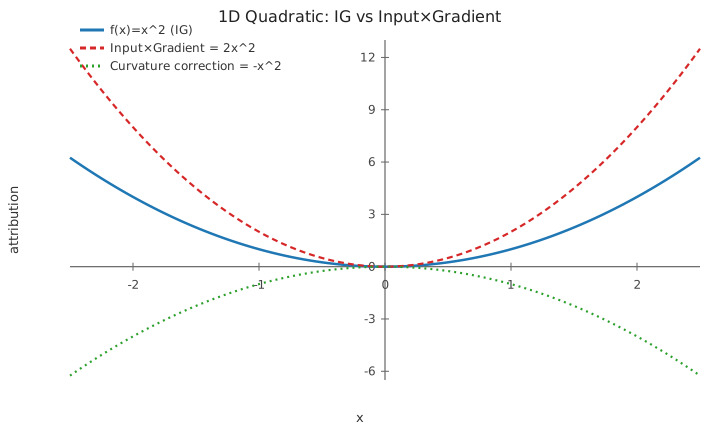
Let $f(x) = x^2$ with baseline $x_0 = 0$. Then $s = x$, $\nabla f(x) = 2x$, and $\nabla^2 f = 2$.
Integrated Gradients:
\[\mathrm{IG}(x) = x \int_0^1 2\alpha x \, d\alpha = x \cdot \left[ x \alpha^2 \right]_0^1 = x \cdot x = x^2.\]Input×Gradient:
\[x \odot \nabla f(x) = 2x^2.\]Curvature correction:
\[\bar{H} = \int_0^1 \alpha \cdot 2 \, d\alpha = 1, \quad -x \odot (\bar{H} x) = -x^2.\]As we can see, $\mathrm{IG}(x) = \text{Input×Gradient} + \text{Curvature correction} = 2x^2 - x^2 = x^2$. For a convex quadratic, Input×Gradient overshoots and the curvature term fixes it.
Citation Information
If you find this useful, please cite this blog via:
1
2
3
4
5
6
@misc{Ramsauer2026,
  author = {Hubert Ramsauer},
  title = {What Input×Gradient Misses: The Curvature Behind Integrated Gradients},
  year = {2026},
  url = {https://HubiRa.github.io/posts/ig-second-order/},
}
References
M. Sundararajan, A. Taly, Q. Yan, “Axiomatic Attribution for Deep Networks”, ICML 2017. ↩︎ ↩︎2
A. Shrikumar, P. Greenside, A. Shcherbina, A. Kundaje, “Not Just a Black Box: Learning Important Features Through Propagating Activation Differences”, CoRR abs/1605.01713, 2016. ↩︎ ↩︎2
M. Ancona, E. Ceolini, C. Öztireli, M. Gross, “Towards Better Understanding of Gradient-Based Attribution Methods for Deep Neural Networks”, ICLR 2018. ↩︎